




September 24, 2011

This was the first time I had to follow a marshaller to parking. The weather was great, the event was well attended -- for 2010s anyway.
I was a little surprised to see a Remos GX, N90GX, an exact sister ship of N28GX, carrying passengers for a trip around the patch. The airplane came down from Las Vegas area in Nevada. It took 6 hours with 1 stop.
Spaceport America had a panel presentation in the pilot's lounge, with William M. Gutman, Director, Technical Division, on hand to answer questions. Unfortunately, Dr. Gutman told me that the my burning question, if I can land on their runway, cannot be answered at this time. Their tour contractor, IDEAS, is still working on the accomodation plan.
I flew our Arrow down to event. It indicates about 125 and trues at 148 mph, which falls a bit short of the book value, and noticeably slower than Mooney, on the same engine. This may have implications for cross-countries, as I was more optimistic for per-mile costs. Note that the engine only outputs 65% power at our altitudes.
Posted by: Pete Zaitcev at
01:24 PM
| No Comments
| Add Comment
Post contains 185 words, total size 1 kb.
September 12, 2011
My first glider ride was more than 3 years back. I was rather overwhelmed and did not understand a thing about flying the thing. Controls seemed far too sensitive and impossible to center, etc. When I came to Moriarty for a fly-in last Saturday, I thought it was a perfect opportunity to revisit the issue.

When we took off, at first it was exactly like before, but with some stern instruction from Steve, I started to understand. Firstly, although sensitive to small stick movements, Grob 103 requires hefty rudder inputs. Also, it settles down with a big delay. Secondly, it is essential not to over-react to decreasing airspeed. In most basic airplanes you really do not want to get too deep on the back for the power curve (this is especially true in C150). If airspeed starts to decay, you either enter a nose-down input immediately or you stall in seconds. Not so in Grob. To begin with, a glider is always on the front of the power curve. Also, you get ample warning about impeding stall from the sound of the wind. So, it is productive not to look at the instruments at all, and maintain the pitch attitude. That was basically it, I can fly a glider now, albeit not very far and only after a release.
There really was not much to the basic flying, but of course a glider pilot has to know quite a bit before a solo: boxing the wake of the tow plane, finding the air currents, landing 100% successfuly each time from any approach, and so on. But I think I could do it, with practice. The question is, do I want it?
Sailplane is a bucket of fun, no doubt about it. Also, the flight hour is quite cheap, if you can stay up (although it is not amazingly cheap: $50/hr at Sundance -- this is only 50% off the wet rate of Remos or C150, plus the tow). But I rather prefer the practical side of aviation: going places. It is possible in a glider, but not easy, or practical. Unless I can fit into Phoenix, I do not see myself as a glider pilot.
Posted by: Pete Zaitcev at
07:08 PM
| No Comments
| Add Comment
Post contains 368 words, total size 2 kb.
September 11, 2011
After a whole lot of spinning the AF447 report, Ubu comes up with this brilliant conclusion:
Unfortunately, some U.S. carriers have bought Airbus 330, including Delta and Northwest Airlines -- and a lot of Asian companies, including Cathay Pacific and Thai Airways. So even if you avoid Air France, you're not guaranteed to avoid these unstable, fly-by-wire-and-computer airplanes.
There's only one small problem with this: consider what would've happened if it were a 747 that lost the airspeed indication and pilots made the same inputs. I can tell you: they would've also stalled it, but instead of riding an airplane that remained controllable, they would've spun in and reached the surface in many fragments. This is what happens if you stall an "iron" airplane with swept wings at altitude (the corner of the envelope in which an airliner cruises is called "coffin corner" for that reason).
Least you think I am exaggerating, things like that happened many times (although personally I only remember cases of Tu-154 spinning in from cruise, due to the way my interests were focused). The simple fact is that computerized airplanes save lives.
The failure of AF447 crew was not keeping the pitch even after the airspeed indication ceased, since the gyroscopic information remained. Sticking with it would've prevented the stall (although I'm not sure if it would've broken a well-developed stall). One problem, however, is that it's extremely hazardous to make abrubt nose-down inputs in an airliner. A test flight of An-148 went down because, just like on AF447, its airspeed indicator failed and the crew responded with nose-down inputs, which were often called in hindsight from AF447 crew. The airplane oversped and broke up in mid-air.
In my opinion, A-330 is a safer airplane and any of the Boeing's old iron, and Ubu just has no clue about the topic, at all. That said, pro made a certain pushback towards basics of flying (e.g. Rapp did, although, oddly enough I do not see either Mac or Karlene addressing it in my feedreader's cache). Note, however, that in case of AF447 we'd be talking about basic flying, but not visual flying, because outside references were not available (it was pitch black over the ocean, like when JFK Jr. died -- and he wasn't flying an "automated" airplane). What really should be done is an improvement in training curriculum that includes airspeed indicator failures in particular, and partial panel in general. Oh, and bring up the fully-computerized 787 online sooner. That will help to shut up the Airbus haters.
Posted by: Pete Zaitcev at
04:03 PM
| Comments (2)
| Add Comment
Post contains 428 words, total size 3 kb.
September 10, 2011
At a local fly-in today, someone arrived in a 1948 Swift (according to Wikipedia, it was built by TEMCO post-bankrupcy). That thing looks absolutely stunning.

I am somewhat familiar with the trajectory of improvement of Mooney and Bonanza, and you would not find me in a 1948 Mooney. But the quality of this thing is just outstanding. It looks like something from 1960s.
Posted by: Pete Zaitcev at
07:30 PM
| No Comments
| Add Comment
Post contains 66 words, total size 1 kb.
September 03, 2011
I was going to take the Arrow down there, but in the last moment it was taken off line with a stabilator issue. I figured that the cheapest option would be the 150, which ended costing $400 for 4.6 hours on Hobbs (after refueling deduction).

This time I arrived only 30 minutes late (came after the official end last time), but a significant chunk of it was wasted on fishing out the fuel probe that I dropped into the tank. I think I came very close to getting stuck away from home base in a rental airplane, but no harm done in the end.
Posted by: Pete Zaitcev at
07:26 PM
| No Comments
| Add Comment
Post contains 109 words, total size 1 kb.
August 19, 2011
This time of year, in the Monterey bay, clouds form so-called "marine layer": a low blanket of stratus over the water. The prevailing winds blow it onto the land, where it burns away. Watsonville is located in an interesting way: the boundary of the cloud bank continuously shifts in and out of the airport. Standing outside, one can see how they fly above and dissipate.

I did not take a picture, but above is a picture of a similar cloud bank in San Francisco the day before. Here's what it looks from above, looking from above the bay towards Watsonville:

And here's a look from below, on the final into Monterey:

When we flew the Eaglet, the wind changed and pushed the clouds from the southwest, so we landed on runway 8. Most of the time though, traffic uses the 20, coming down in the clear and taking off against the cloud bank. It actually tops lower than the pattern altitude. I saw a Cub and an Eaglet take off, Cub took the right turn, and Eaglet took a left turn to avoid clouds. A Bonanza also departed and went straight ahead, outclimbed the clouds, and disappeared towards the north. This mode of departure was associated with a ridiculously stupid crash a month ago. A Mooney did exactly the same that the Bonanza which I saw did, but he could not quite make it. Then, instead of keeping the wings level and airspeed at Vy, he tried too hard and hit a departure stall. Of course, entering a cloud would be illegal, but what is more preferable: write a report (if they catch you), or die and kill your whole family?
Flying in the great Southwest, I questioned a need for an Instrument rating. If we have an IMC, it is a "hard" IMC. You do not want to brave it in the rental singles even if you're rated. So, it's a waste of time and money to get rated. But the marine layer like the above is a perfect example of "soft" IMC. Flying on an instrument plan would let one safely fly in and out of coastal airports (although, beware of the ice), while VFR pilots remain grounded. You do not want to scud run under those layers.
Posted by: Pete Zaitcev at
08:05 PM
| No Comments
| Add Comment
Post contains 384 words, total size 2 kb.
During a trip to Norcal, I had an opportunity to try out a Tecnam, offered by Ocean Air out from Watsonville (KWVI). They had a P2002 in the fleet, but like every other low-wing LSA that I tried, except Evektor, it turned out to be too small for me. The high-wing Eaglet, however, is acceptable. The visibility is not worse than out of C150.
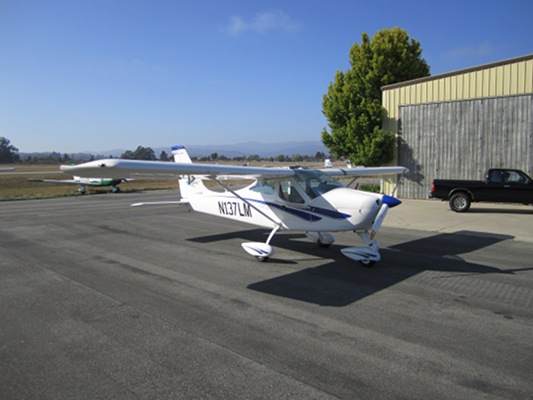
For an airplane with the class-leading payload, E92 looks surprisingly low-tech. Traditional sticks, aluminum parts. It even has toe brakes with 2 sets of master cylinders. I suppose not having a folding wing or BRS helps, but with 2 big guys onboard you can almost take full fuel. It flies like everthing else, but adds a 1:12.8 glade that flaps hurt only very little, so it needs a Moonesque flat approach. Fortunately, it slips with ease.
P.S. Forgot to mention that it's my first flight at sea level. The runways there are tiiiiny. But it was not that big a deal. What was a big deal was the marine layer. I'm going to post about it later.
Posted by: Pete Zaitcev at
04:33 PM
| No Comments
| Add Comment
Post contains 185 words, total size 1 kb.
August 13, 2011
An article at Examiner (via), poorly sourced, reports that the Langley center (home of HL-20, Morpheus, and other innovative programs) is considering swapping out the solid for liquid engines for Max Launch Abort System. The most notably feature of this development for me is how they only got around to it after Boeing and SpaceX started development of liquid-fueled abort systems for CST-100 and Dragon respectively. In case of Boeing, test firings were already carried out in order to qualify the existing "Bantam" engine that they plan to appropriate for the program. SpaceX are aiming to leverage their "Draco" engine experience with a "SuperDraco", and preparing for the tests. For many years NASA was expected to be the technology leader by default, but no more.
Note that I am agnostic regarding the MLAS itself, or its switch to liquid power. Initiated by Mike Griffin's famous napkin sketch, MLAS was a clear loser to the traditional tower system developed by Orbital under the management of Marshall center. It was much heavier than the tower and turned out ridiculously complex once Mike's vision was applied to the real spacecraft. It was only kept alive by NASA launchers being so ridiculously tall, that they would not fit into the Vehicle Assembly Building with the tower installed. The commercial systems from Boeing and SpaceX derive the advantage from being built into the respective spacecraft. But MLAS is separate from Orion. Due to the excellent efficiency of modern solid fuels, and the necessity to use inefficient pressure-fed liquid engines, there's not going to be an outright performance advantage. So, whatever. I just find it amusing how NASA is following the lead of commercial upstarts.
UPDATE: Gary C. Hudson commented "It's only an attitude control thruster, not main LAS propulsion."
Posted by: Pete Zaitcev at
08:15 AM
| No Comments
| Add Comment
Post contains 300 words, total size 2 kb.
August 05, 2011
Accroding to a local newspaper, there was an intercept:
A 75-year-old South Barrington pilot got the surprise of her life when her small plane (a Kitfox 2 -- ed.) was intercepted by two F-16 fighter jets Wednesday night after it entered restricted airspace temporarily put in place for President Barack Obama's visit to Chicago.
NORAD officials said Rose's plane did not have a radio, forcing the Command to scramble the jets to identify it. The jets intercepted the plane, forcing it to turn around and return to its home airport at Mill Rose Farm, [NORAD spokesman Lt. Michael] Humphreys said.
Note that the old lady has taken off her own farm. The popularity of TFRs made getting in your airplane and flying hazardous in the recent years. You must check in with tfr.faa.gov or the flight briefer before the flight. This is not a phenomenon that President Obama has initiated, but rather something that was gradually screwed up after 9/11.
UPDATE: SF Gate has a researched article which identifies the aircraft properly (it's a Cub). It also mentions that Mrs. Rose knew about the need to check tfr.faa.gov, but her computer "was not working properly".
Posted by: Pete Zaitcev at
01:53 PM
| No Comments
| Add Comment
Post contains 195 words, total size 1 kb.
August 04, 2011
At AVweb again, a report of Icon A5 (discussed here previously) flying with the new wing, which is supposed to be "spin-restant". The included picture clearly shows tip cuffs at about 1/4 span. Also, supposedly there are no flaps anymore. Pictures of the A5 with the old wing at Icon website clearly show flaps deployed.
BTW, their gallery includes a picture of A5 touching water with a wingtip in flight, with the following caption: "this maneuver is performed by a professional test pilot for testing purposes only and is not an action that ICON encourages any pilot to attempt due to its potential danger." Well, I'll be damned! It can be done!
Posted by: Pete Zaitcev at
05:35 AM
| No Comments
| Add Comment
Post contains 120 words, total size 1 kb.
News from Korea: a new GA airplane, KC-100 "Naraon", takes a flight. It appears to be a competitor for Cirrus SR-22 (now owned by Chinese) and Cessna Corvalis. KAI promises 210 kts with 1100 lbs payload on 315 hp from a TSIOF-550-K gasoline-burner. The presser, as regurgitated by AVweb, promises a price target of $575k. The immediate question in my mind is what are users in CJK countries expected to burn in this thing. This is a turbo, so it may not take easily to autogas. Do they even have 100LL?
Posted by: Pete Zaitcev at
05:24 AM
| No Comments
| Add Comment
Post contains 96 words, total size 1 kb.
July 30, 2011

I figured that at $22 at Amazon, there was no excuse not to have one. The result appears to be another useless gadget. At 5000 ft it shows 97, at 10000 ft it shows 92 (although impossible to read in the picture above), which seem to be rather ordinary numbers.
Actually, I may be too quick to dismiss it. For example, on the way back from FTG, I could conceivably climb until the oximeter shows 90 and then see if I can make La Veta pass... if weather were perfect. In real life even that kind of use seems unlikely.
What I think would be actually useful is a CO detector. But those are expensive and bulky.
Posted by: Pete Zaitcev at
06:51 PM
| No Comments
| Add Comment
Post contains 119 words, total size 1 kb.
July 26, 2011
I'm back from KFTG, where I scored a ride in a 1967 M20E of Alliance Flight Training.

Everything they say about Mooney is true. For example, it has great low speed handling, even if hard to get to that low speed. It's crazily fast, for an airplane with 200 hp engine: 140 mph true easily (which, coincidentally, is about 140 knots groundspeed in the summer, cruising at 10k). A Cherokee trues at about 105 mph, for comparison. But it is not the whole truth.
There's a certain air of unfriendliness about the airplane. Or, rather, remember how they said that UNIX is friendly, it is just selective about who its friends are. Right away I pinched my skin upon the gear lever's handle. Checklists are long and unwieldy, flows have points all over the cockpit, the fuel switch is so tough that some pilots use a tool made from PVC pipe. The said switch also goes through the "off" position when going between tanks. Some things are nice, like the baggage door, but overall the airplane seems like a product of ordinary design added on top of a few excellent points inherited from Al Mooney. The hydraulic flaps is probably the most striking feature in this regard. Someone sat down, considered all limitations (e.g. no place to put Cherokee-style Johnson bar, electric flaps would be heavy and unreliable) and came up with this. An excellent designer would feel injured by putting hydraulic flaps into an airplane with manual gear retraction until he came up with a better solution. Or at least this was my impression from looking at it postfactum.
I think I want to try a Bonanza now.
Posted by: Pete Zaitcev at
05:33 PM
| No Comments
| Add Comment
Post contains 282 words, total size 2 kb.
July 20, 2011
The Grove is the best breakfast place in ABQ, period.

The bread is actually edible (I'm sorry, Church St. Cafe, but it's the truth). You do not need to scrape the chili off everything. The service actually exists (unlike Slate).
Two words of caution though: 1. closed on Monday, 2. fills up suddenly and becomes unusable when lunch hour strikes.
Posted by: Pete Zaitcev at
12:48 PM
| No Comments
| Add Comment
Post contains 61 words, total size 1 kb.
July 17, 2011

Flying to Escancia E92 was a relatively old goal. After Del Sol turned my request down, I went to Bode, read carefuly their renter's agreement and manual, and read my own insurance agreement. I have one with Chartis (ex AIG, through AOPA), and it says not to land at surfaces not maintained as a public airport. But Estancia is a maintained public airport, just without asphalt. So, I'm not only legal, but also insured for flying there.
I used about 2,500 ft to land and 2,200 to take off (according to Google Maps). I did not aim for an amazing feat of short-field performance, but rather for comfortable and safe operations. For the same reason, I both landed and departed from rwy.8, as obstructions are on the west side, and it's much easier to descend than to climb over them in a C150. Really, a non-event, but a fun one.
The sound that gravel makes is quite disctinctive, and also it offers a lot of resistance to rolling. I tried to be very careful not to use excess power, in order to save the prop from dings, and looks like it went fine.
Posted by: Pete Zaitcev at
11:20 AM
| No Comments
| Add Comment
Post contains 195 words, total size 1 kb.
July 13, 2011
In the context of Dr. Zubrin suddenly deciding that super-mega-heavy lifter is not necessary to reach Mars after all, Clark Lindsey remarked on May 23:
It's long been clear that the one and only thing that matters to Mr. Zubrin is to get a human mission heading to Mars as soon as possible. Pursuing advances such as building up a commercial human spaceflight industry that provides low cost access to orbit, developing an in-space infrastructure, using the Moon to learn how to do in situ resource utilization, finding ways to deal with human factor issues (particularly radiation & microgravity health effects), etc. is all a waste of time to him. However, as seen by his recent WSJ essay on a Mars mission with the commercial SpaceX Falcon Heavy, he is quick to take advantage of such advances when they are near at hand. I'm sure that once propellant depots and other such systems are in operation, he will no doubt incorporate them as well into new Mars mission schemes. And the abuse he hurled at such efforts and at the people who supported them will be long forgotten.
This flexibility undermines Dr. Zubrin's attacks on VASIMR. If VASIMR suddenly works, no doubt it's going to be a centerpiece of then-in-vogue Mars Drirect Mk.XXIII architecture. Not that I'm a fan of plasma-electric propulsion with non-existing magnets, but just saying.
Posted by: Pete Zaitcev at
07:52 AM
| No Comments
| Add Comment
Post contains 231 words, total size 2 kb.
July 10, 2011
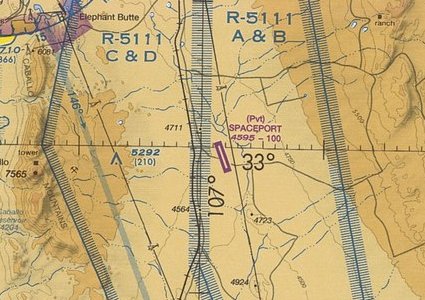
I noticed that the runway of Spaceport America is depicted at sectional chart now. Private, of course! For those not in the know, it means that I cannot land on it without a prior permission even when the restricted area R-5111A is not active. Taxpayer money well spent, I guess.
UPDATE 2011/09/24: Dr. William M. Gutman told me that FAA is considering a proposal to create a "keyhole" corridor through the restricted airspace.
Posted by: Pete Zaitcev at
09:03 AM
| No Comments
| Add Comment
Post contains 78 words, total size 1 kb.
July 07, 2011
The first date with Arrow went about as expected, but the difficulties were not where expected. The speeds are only 10-12% higher, but some behaviours are unexpected, especially the rudder response. The only ball remaining is the little electronic bar on the PFD, and I don't know how trustworthy it is. Otherwise, I'm going to get my complex endorsement if I refrain from screwing it up next time.
Arrow is just as nose-heavy as newer Cherokees... Not just at controls, but also in W/B. I had to use ballast to make it close with a 160 lbs instructor! On the upside, it is the first airplane where I do not have to put the seat at the last notch. Sorry, no pictures; maybe next time.
Posted by: Pete Zaitcev at
01:02 PM
| No Comments
| Add Comment
Post contains 127 words, total size 1 kb.
July 02, 2011

I am just back from Artesia, where I had the very traditional pancakes. I am getting used to Remos, but it's still quite crampled. Also, it's not as fast as I remembered. It went with about 83..85 kts KIAS @10k and 90..95 kts GS. But it is still amazinly easy to fly, especially after the quirks of the Cessna 150. You basically point it with the joystick and it goes there.
Lance, the owner of the FBO, told me at the sight of a GX that he's getting a 162. I don't expect it to end well. I mentioned it to Michael, owner of the N28GX, and he said that the plane just about breaks even if it flies 30 hours in a month. I also heard numbers as high as 500 hours a year for the plane to turn support a school (I think Dr. Such said something like that). And Artesia is very much a backwater, there aren't many people there. Therefore, not many renters.
On the other hand, Del Sol's beautiful Coguar does not have renters signing on standby either. I think they bought it mostly for bragging rights. Maybe this 162 in the middle of nowhere is also a kind of a flagship, which does not have to turn a profit by itself.
P.S. I just realized that the FBO is owned by the city, and Lance is merely the airport manager. That may explain things.
Posted by: Pete Zaitcev at
02:41 PM
| No Comments
| Add Comment
Post contains 243 words, total size 1 kb.
June 23, 2011
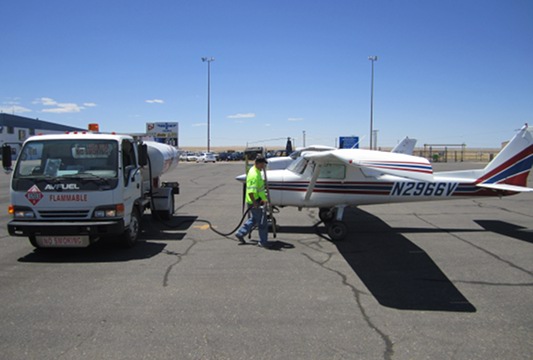
The wind was much lower today, only 10 knots. I was able to experiment freely with the back side of the power curve and I think I am getting it now. The thing about the 150 is how sharp the curve is. Once you got it slowing beyond Vy, it immediately starts slowing even more, and will quickly run out of airspeed. It also develops truly disconcerning sink rate and angle. The earlier you catch it, the quicker you put nose down, the less is the speed loss before recovery. I think a sharp pilot should be able to exploit it for short field landings, by balancing the plane on the back side of the curve. Cherokee, by contrast, has a reasonably flat top to its power curve and does not require anywhere near as sharp reactions. Just power it up and down as you want, and it extends or shortens the approach in a predictable way.
Can't say I'm an ace in 150 now, and in fact I ended completely lazing it by flying in with 10 to 20 degrees of flaps and then touching down at 60 mph. Oh well, it will have to do.
P.S. Why are we talking about the power curve if airplane glides down? That is because the loss of potential energy is tantamount to power over the same period. There is, however, a little trick to it: when a pilot sets RPMs or manifold pressure, that is pretty much it, but the power derived from descent depends on the rate of descent. If the back of the power curve is not steep, this can create a stable system: as airplane steepens its descent, the "power" grows and it extends the glide. But 150 is not like that.
There's an explanation of power curve in John Denker's See How It Flies. But to the best of my recollection, he does not make a connection of descept rate to power and thus the position of airplane on the power curve.
Posted by: Pete Zaitcev at
10:00 PM
| No Comments
| Add Comment
Post contains 341 words, total size 2 kb.
26 queries taking 0.1686 seconds, 68 records returned.
Powered by Minx 1.1.6c-pink.