




December 23, 2011
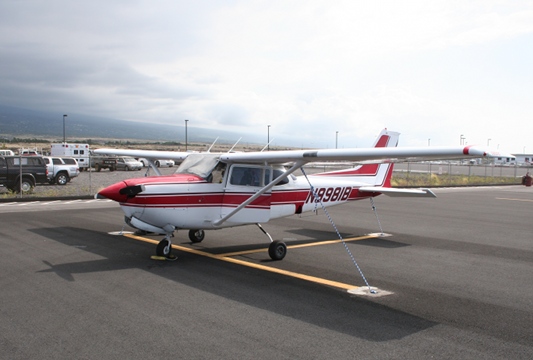
My deep-seated belief that my instructors were too nice for my own good received new food when I went up with Mr. Jon Pickering in a C-172RG of Iolani Air. Jon identified 3 areas that needed urgent improvement:
- Power (mis-)management. He wants me to climb at full power out of an airport, then transition to cruise by letting the airplane accelerate, and then fly at cruise speeds and the most efficient power setting. Instead, I bump the power down as soon as I can, set 2200 RPMs, and then fly the throttle around 21" of MP. I am so used to be stingy and bump the throttle down as soon as I sense an updraft. But Jon implied that it's not good for engine, but more importantly it triggers other bad habits.
- Flying the trim. Since I play with power, I have to chase it with trim, and in the end I start flying with the trim. I need to break this and get back to flying with the yoke. It may even help me stay on the desired altitude, which I don't.
- Staying on the centerline. At the final, I am sloppy getting on the centerline. I enter a slight correction towards it and get roughly on the centerline some 300 ft up, then make finer corrections and line up for touchdown. At Waimea, this just does not work, because it prevents me from sensing changes in deviation immediately. It is too gusty. I should get strictly on the centerline early, and apply corrections promptly. In the event, my corrections grew larger and larger, and I had to call a go-around from 100 ft.
There was way more than that. I bounced us off the runway at touchdown in Kona at first. I forgot to raise the gear. I "set" the VOR instad of DG (not the first time it happens to me). My radio work is atrocious. I also flew 500 ft above a helicopter head-on: I knew he was there, but could not acquire him until we were 2/3 mile away. It was kind of fun in a bad way.
Even after all is said, I think I could've circumnavigated the island, or made the right decision to turn back, on a good day like that. But I need to be way more on the ball for the instructor to be able to forego teaching basics and move onto the local weather.
Posted by: Pete Zaitcev at
03:46 PM
| No Comments
| Add Comment
Post contains 409 words, total size 2 kb.
December 19, 2011
On my landing into KABQ, Delta MD-90 was being recovered on runway 3. Everything was routine until the moment they tried to take exit Charlie, which airliners normally take since it's configured as a high-speed exit and leads straight to the air carrier terminal. A burst of braking followed by weaving as they realized that they're not making it. I think we took Delta (it was dark, so I'm not sure, could've rolled all the way down). I was mentally preparing to ask casually "oh hey guys, did you try to make Charlie", but by the time we deplaned, the crew was already gone. Usually Captain or F/O stands at the door to wave us good-bye. Oh well, it's to the best, I guess.
Posted by: Pete Zaitcev at
01:14 PM
| No Comments
| Add Comment
Post contains 127 words, total size 1 kb.
December 03, 2011

Today was extremely educational, as I spent the time between 5 and 10 a.m. at the airport, waiting for the weather to improve. By necessity, I had a received a great opportunity to compare the actual weather with reports. The Prog(nostic) Chart won my especial admiration for the concise way it summarizes the picture. Before, I was rather confused about the right way to interpret it. Oh sure, I knew all the symbols. I passed a strict exam about it. But I was rather like Dr. Feynman's Brazilian stundents in this regard.
Yet it's simple like an apple. Click on the current surface analysys. That's clear enough, right? Then... Click on the "next" button `[>]'. It works in the same way as on the Satellite product. Voila. Beautiful.
Because New Mexico's flying weather is so mild, I managed to put in a couple of cross-countries in the 300 nm rage without thinking about weather at all. In the summer it basically comes down to flying direct towards the destination, and going around any thunderstorms. There are no squall lines like in Georgia, no solid overcast like in Ohio. The only problem is wind, which closes mountain passes. In the winter it becomes a bit more interesting. We may even see.. *gasp* ice! Yeah. No wonder that my ability to read Prog Charts never developed.
Posted by: Pete Zaitcev at
06:55 PM
| No Comments
| Add Comment
Post contains 228 words, total size 1 kb.
November 27, 2011

I am back from taking Bonnie Mauldin's Flight Design CTLS to a practice area. The capsule summary is: a nice airplane except for center console ergonomics. Vizibility is much better than out from Remos GX, thanks to sensible door frames. I do not have to remain bent like a question mark in CT. The lower edge of the dash mushroom is high enough, and the seats are far enough from the ruddger pedals that I can put my feet down naturally.
People always write about the flaps in CT. I do not think they are a problem. The basics are simple: take off and land with flaps down ("15"), fly around an airport with flaps neutral ("0"), and cruise with flaps up ("-6"). That's all there is to it.
The handling is ordinary. The only thing to watch out is how it likes to sink in turns, so bump that power up and pull. The spring-loaded control surfaces feel a bit weird, but on the upside all 3 axii are trimmable. Although, this includes the first snag: ridiculously stiff elevator trim, and the wheel being inadequate. I imagine putting one's thumb to it gets old fast (GX has a convenient electric trim).
The center console in general is where the designers messed up. The throttle lever gives the setup an upscale, airliner look, but I have to put my fist around the stem, or else I cannot set the right power. It's ridiculously inconvenient, especially compared to dual button throttle on GX. In flight, the handle obscures the flap switch. On the ground, I bumped the throttle out of idle every time I reached for the brake lever (which has to be pulled). There's a definite control interference problem. Some of it is intentionally designed in: the fuel shut-off blocks the ignition key. That's going to be an epic fail when the time comes to fumble the key during an engine fire. Oh, an the carb heat is at the top of panel, because an extra challenge during go-arounds is good for you.
BTW, Bonnie's airplane is noticeably faster than Michael's: it goes 100 knots at 4800 RPMs with the two of us. Book values are about the same on both. It may be the prop, or perhaps the flaps.
Posted by: Pete Zaitcev at
11:54 AM
| No Comments
| Add Comment
Post contains 384 words, total size 2 kb.
November 25, 2011
According to Phoenix ABC 15, 3 small children were on board of a Twin Commander that smashed into Superstition Mountains yesterday night. There's a YouTube video from a security camera.
The first lesson is obviously the dangers of night VFR. But without removing the blame of the two grown idiots who thought it was a good idea to avoid the hassle of rerouting by dodging rocks in the dark, look at pictures posted to PoA. Dodging Bravo is difficult at the best of times, and rocks made it much worse. Frankly I am quite unimpressed with the "air grab" that is going on around "the nation's busiest airports". But what to do? We have the big airline businesses on the other side.
By the way, for some reason, journalists call the Twin Commander "small". It's not really.
QUICK UPDATE: The menacing floor of Bravo not always made people run into mountains. It was in fact lowered from 8000 to 5000 a few years ago. Here's a quote from AOPA letter, objecting to the "air grab":
East Valley Airspace [proposal] Flawed
AOPA is opposed to lowering the floor of the Class B sector over the East Valley area from the current 8,000-foot floor down to 5,000 feet msl. The TRACON's proposed floor of 5,000 feet extending to 25 nautical miles will not only severely hamper GA's ability to transition the Phoenix airspace to the east but is being proposed to allow PHX arrivals to descend lower on visual approaches to parallel downwinds -- the very scenario that when educating the surrounding Phoenix communities, the FAA claimed would NOT OCCUR.
Between the Superstition Mountains to the east and Falcon Field (FFZ) Class D to the west, there is literally nowhere for GA pilots to transition on the East side of PHX. And just as the TRACON and ATC heard repeatedly in the public airspace meetings and acknowledged during a telcon with AOPA in early May, the lack of GA services available from the Phoenix TRACON makes it impossible to transit within the Class B airspace area. Furthermore, the TRACON's proposal will not permit GA pilots to fly at least 2,000 feet over the Superstition Mountains Wilderness Preserve, which would be against FAA's very own guidance as spelled out in Advisory Circular, AC 91-36. [...]
But the lowering was implemented anyway, because it saves fuel for big airlines. This is how your government kills you.
UPDATE: Rob reposted to Facebook.
UPDATE 2011/11/29: Here's an article by Jim Walsh in Arizona Republic:
Ian Gregor, an FAA spokesman, said he cannot comment on specific crashes but said general-aviation pilots can request clearance from control towers to enter the so-called Class Bravo airspace when necessary.
True enough, we can request. But then quite often we hear "Remain clear of Class Bravo". Last time I received that reply, controller added: "I don't have time to deal with you." It was in DEN Bravo, not PHX, but same principle applies.
Mike Huhn, a National Transportation Safety Board investigator, said he is examining the airspace-redesign issue as one of many potential contributing factors in the collision.
"They are all correct statements. Therein lies the fingerpointing,'' Huhn said.
Mr. Huhn is right, and my own post above borders on fingerpointing.
UPDATE: NTSB report for N690SM is WPR12FA046, November 23, 2011.
Posted by: Pete Zaitcev at
02:21 PM
| Comments (2)
| Add Comment
Post contains 555 words, total size 4 kb.
November 13, 2011
Amazon MP3 is the greatest thing since baked bread, since it's DRM-free, but its indexing is just useless for anison and J-pop. It plainly has no clue that such a category even exists. At first, I searched by name, but that was like searching needle in the haystack. No Ayumi Hamasaki, no nuthin. Only the blasted Utada as far as eye can see. Then, it was mostly trawling carefuly through lists and "customer who view this, also..."
One of the most annoying pests is "I Love You! Project", which floods search results with ear-rending instrumental remixes. Their production is the worst... except Anime no Magic. The Kimi To Yakusoku Shita is particularly rad. Typically, there's no artist credit. Who sings? Who plays? Mystery!
Miku Hatsune floods too, thanks to mediocre creators seeking opportunity. Still, genuine hits are represented, such as Sososo's Next Stage, which once reached the top of Oricon in CD single form (true story!). After buying all of Sososo's Miku stuff, it begins to sound about the same, so for the sake of difference, check Biruru's Dou Demo Ii. It may not necesserily be Sososo's fault, Miku's range is not that great. However, creators have a lot of trouble breaking away from her. The best Luka track I found so far is Stay by my side.
KOTOKO: Actually, She Is At Amazon. There's one album, where she only took a part: Disintegration. It's an early one, so I hope for more, in the years ahead.
AKB48: They sound surprisingly amateurish to me (Sorry, J!). However, I gave them a good try after reading this review:
This is a really creepy and sexist phenomenon. Nevermind the typical soulless music, this industry does everything to make these girls seem as generic as possible so they can easily be replaced, like homogeneous puppets pumped out by some machine. [...] Congrats, Japanese teen idol industry: I'm not politically correct by any means, but you managed to ruin my day. I wish people wouldn't tolerate these kinds of dehumanizing messages in popular media.
My favourite AKB48 track is probably Kimi to Niji to Tayou to. I can just see jamming on the synth for them (even though with the way multi-tracks are recorded in reality, it's a pure illusion).
Stereopony is some kind of real-life ENOZ that found financial backing. They look like they broke out with a couple of singles, Hanbunko and Smilife, to be followed by generic stuff.
Another one-album wonder is Megumi Oukutsu, with Asu Heno Tobira. The poor thing did not even get the lifespan of Stereopony. Frankly, she beats the pants off the collection of singles that Yoko Ishida recorded in the twilight of her career.
I did not find Scandal's work to my liking, with a possible exception of Yumemiru Tsubasa. Also, I suggest sampling Maihime's Hiryu, just for the heck of it. And the final oddball is Go, by Flow: the token anison in the album, and yet sounds more entertaining than the rest. If you want to get depressed, try to find Haruka Kanata. There is even a vocal imitation (and a bad one at that).
UPDATE: J. commented that AKB48's music is "pretty bad". Well, that settles that. Although, he should try that one track that I linked.
Omo reminded to mention a Miku author Supercell (not the other Supercell, a band). As far as critical acclaim and royalties, Sososo is pretty much unbeatable.
J. also added:
Oh, and if you didn't know, AKB48's producer has been in the idol game a long time, having been responsible for the original giant girl group, Onyanko Club, and after inspiring Tsunku to create Morning Musume, he returned to crush them.
UPDATE 2012/02/04: Found Minami Kaze by one Mikuni Shimokawa. Unfortunately her renditions of classic anison are rather odd, so I prefer Yoko Ishida's, even if they're remixed into Para-Para.
Tags: anime
Posted by: Pete Zaitcev at
03:33 PM
| Comments (3)
| Add Comment
Post contains 651 words, total size 6 kb.
November 12, 2011
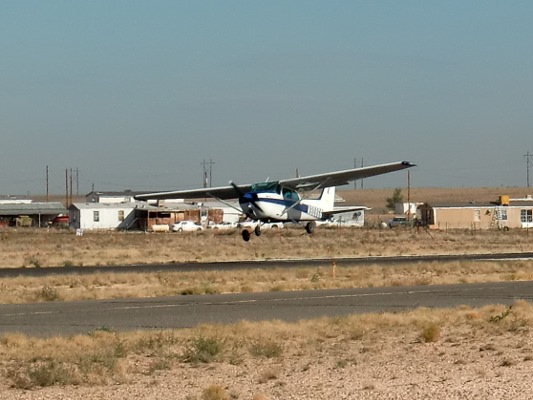
Pictured: another student from our school, demonstrating a crosswind correction in N80866.
I looked at the seat tracks the first thing, and they seemed not any worse than those in Piper. But when I tried to settle in, it turned out that at the seat hitting the rear stops, I cannot reach the controls, despite being unusually tall. No wonder that people kill themselves with unlatched seats in Cessnas, but not in Pipers.
Also, it may be related, but in every other old 4-seat GA airplane two grown Americans push the envelope in the front. In Piper Arrow, I had to use actual ballast! Not in the 172 though: we hit the envelope about 2/3 to the back.
The airplane is very easy to fly. Landings require speed control: don't land fast, don't land slow. Fortunately, it quite easy to keep on the dot (around 70 mph), unlike its older brother C-150. Also, the visibility in turns is better. The only problem that I hit was an excessive sensitivity in the pitch, like what LSAs are roundly reputed to have.
While we were practicing, flaps died on us. It was not the breaker. Either the actuator motor went kaputt, or a wire fell off somewhere. Fortunately, they were retracted when they failed, so we just continued without any drama. Many people dislike electric flaps for the reason of potential failure, but even after today I am not with them. I had flaps on Cherokee unlatch on me with a tremendous slam. Good thing I wasn't landing at a short field at the time!
Posted by: Pete Zaitcev at
07:55 PM
| No Comments
| Add Comment
Post contains 268 words, total size 2 kb.
I cheated by driving in, again. But it's all right, as I'm scheduled to check out in a C-172 later today.
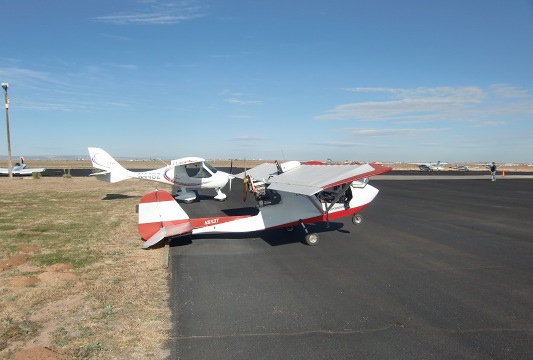
First interesting thing I saw was somebody's Challenger (pictured). It's N-registered, so not a Part 103 aircraft. I am most impressed by the workmanship. The engine installation is extremely clean, compared to what I saw at Tucumcari. Lots of crude materials are used, but with very little machining, but the guy is clearly skilled with a hacksaw and needle.
Behind the Challenger sits a CTSW, N44BZ. If it's representative of CTLS, I think I like it more than GX, from the outside at any rate. They are extremely similar, but the door frames are thinner on CTSW, promising a better visibility. Also, baggage can be accessed without removing the seats and the panel shape promises to be more compatible with my knees. Of course, the airplane is known to be quirky. For one thing, there aren't ouside door handles. Then there are weird fuel vents and negative flaps. But if I can fit better, I think I'd like it more. I should get back to the idea of flying an hour or two with Bonnie Mauldin, as a fit check.
Appropos that, I met two other local instructors: John Loranz and Chester Smith. Mr. Smith is semi-retired these days. He does not teach in his airplane anymore, but continues advanced instruction in customers' airplanes. John does tailwheel instruction and I'm going to give him a call in January.
Posted by: Pete Zaitcev at
12:45 PM
| No Comments
| Add Comment
Post contains 253 words, total size 2 kb.
November 11, 2011
Capsule review:
* Very nice engine; CVT is nowhere as offensive as whatever is used in Fiesta.
* Very little to distinguish from Versa. {Update 2012/01/06: Alex L. Dykes had the same idea.}


Tags: cars
Posted by: Pete Zaitcev at
10:30 AM
| No Comments
| Add Comment
Post contains 37 words, total size 1 kb.
November 06, 2011
Look at this, a T-28!
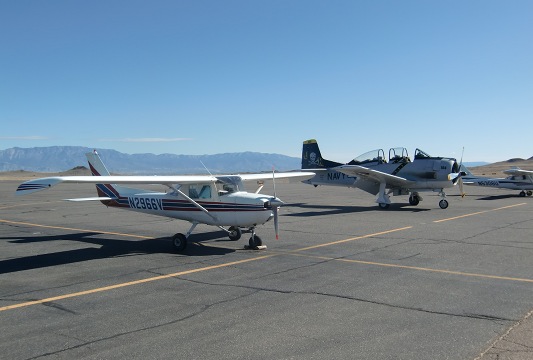
I scheduled a time to check out in a C-172, so keeping in mind the last time, I thought to put a little proficiency/currency hop in. Nothing to report, really, except my ugly patterns. I dialed more and more flap with every landing and it got pretty fun. But now I wish I owned an airplane, with an insurance of off-airport landings. The short field landings and takeoffs are just not as fun when simulated.
Posted by: Pete Zaitcev at
12:11 PM
| No Comments
| Add Comment
Post contains 83 words, total size 1 kb.
October 24, 2011
When writing about the night hop, I omitted how it actually went, and in one word it was bad. The worst part is how easily I slide into complacency, and of course complacency is what kills people the most. I was an Arrow- and Mooney-qualified veteran of 150 hours, and this was the Cherokee in which I took my checkride, so what could go wrong? I mean, you just look at it!

The trouble started right away, when I forgot how to deal with weathervaning on takeoff, and almost departed the upwind side of the runway. Good grief. But that was only the beginning.
On the first landing, I slowed down more than I did back in my student days, because hey, real pilots approach at 1.3 Vs0. You probbaly see where this was going: stalled out of the flare and onto the runway. I was saved by the old habits of floating: the altitude was low, and the nose did not go down enough to impact first. Oooh keey... Taxied back, took off, and then proceeded to bleed the speed almost to the bottom of green arc during the crosswind turn. Oh, and the carb heat was left on. That was taking it too far!
I had to get my shit together or else, so I psyched myself, made a by-the-book approach, crosswind-corrected final and touchdown. But as I started to congratulate myself, something possessed me to examine how well the aerodynamic braking worked, so I started to pull... and popped right off the runway! In crosswind!
Miraclously, I deftly saved the situation with just the right kick of power, but then thought it better to fold up for the night. I clearly wasn't in the right frame of mind. The departure with tail between legs was uneventful, but Albuquerque approach naturally saw fit to sequence me with a Delta jet breathing down my back, and even asked to short-circuit my pattern. I don't know how I managed it. But, here I am.
The outcome is that someone has to take every flight seriously before something bad happens. Also, my upcoming tailwheel work is going to shape like a remedial course.
Posted by: Pete Zaitcev at
04:43 AM
| Comments (1)
| Add Comment
Post contains 364 words, total size 2 kb.
The article itself may be just one of those opinions-opinions variety, but there was an interesting comment by Frederick Stark:
Some years ago I was involved in the development of a single business jet, the Visionaire Vantage. We studied the safety issue in considerable depth and here's some some of what we found. Turboprops have a greater failure rate than turbo fans because of the gear box and propeller. Most of the in-flight failures of the jet engine we selected were because of running out of fuel. The injury and death rate was higher for twin propeller airplanes than for singles because of loss of control and/or higher stall speed. By FAA regulation the stall speed of a single engine jet was 65 kts, the same as for single propeller airplanes. In the event of an engine failure the single engine jet usually glides further than a propeller airplane. The loss of the engine in a single engine jet will result in losing cabin pressure but the bleed off time will allow descent to a safe altitude and is not nearly as dangerous as a window failure. These conclusions were based on independent analysis by safety experts and Department of Transportation data. Our overall conclusion was there is little safety difference between a single or multi-engine jet and the single jet has considerable safety advantages over single turboprops and twin propeller airplanes.
By the way, I also happen to agree that stalling at 65 knots is way too much to be survivable in most terrain, even rather flat. However, BRS may address that concern.
Posted by: Pete Zaitcev at
04:06 AM
| No Comments
| Add Comment
Post contains 270 words, total size 2 kb.
October 21, 2011
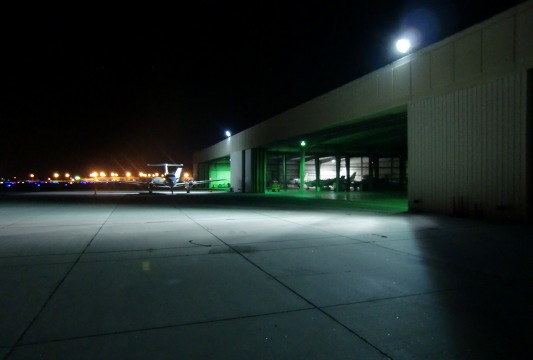
I made a night hop tonight, for the night currency per Title 14, Part 61 Federal Regulations:
§ 61.57 Recent flight experience: Pilot in command.
(b) Night takeoff and landing experience. (1) Except as provided in paragraph (e) of this section, no person may act as pilot in command of an aircraft carrying passengers during the period beginning 1 hour after sunset and ending 1 hour before sunrise, unless within the preceding 90 days that person has made at least three takeoffs and three landings to a full stop during the period beginning 1 hour after sunset and ending 1 hour before sunrise (...)
The requirement applies only if I were to carry passengers, which is not very likely, but it may happen. Just another excuse to fly, anyway.
Airport is different at night, looking more mysterious. Nightfall is early in October, and traffic around 8 p.m. is still flowing quite well. A Delta jetliner was chasing me down at 3, then cut me off at Charlie. Unfortunately, the vibration did not allow me to snap a decent picture.
UPDATE: But wait, there's more!
Posted by: Pete Zaitcev at
09:43 PM
| No Comments
| Add Comment
Post contains 187 words, total size 1 kb.
October 15, 2011
I cannot help contrasting what Meg in her review (via, with a broken link) with my impressions of Remos GX. I'm going to skip things that are similar between the two airplanes. But before that, one unique feature of Garmin 300, which I would like to critique irrespectively to GX:
Weight and balance is done via an application of the Garmin 300, a glass panel designed specficially for the Skycatcher.
To have the W&B in the cockpit is an extremely bad idea, because, unlike an airliner, W&B in a light airplane must impart the decision-making well before boarding. It plays no role when avionics are turned on. If any parameters are outside the envelope, having already boarded the airplane places an undue pressure on PIC to continue.
I was in a situation when the computation demonstrated the airplane being outside its W&B envelope. In one case, we were able to procure ballast (jugs of water). In other case, we switched the airplane to one more permissive. Both cases were helped by making decisions ahead of time so that the schedule was impaired minimally.
Meg missed this important point, instead focusing on students losing habit of calculating W&B by hand — as if they do not use iPad and 'droid apps to do it already.
{Update: Note that it is next to impossible to get a side-by-side 2-seater out of balance, as long as the design co-locates people with the projection of CG. Placing fuel in wings helps. However, my point still stands: W&B calculations must be done well ahead of the flight.}
And with that out of the way, points of comparison.
"We bought the Skycatcher specifically for training,†Cunneen said. "We looked at other light-sport aircraft, but they didn’t look like they would hold up in a training environment. The Skycatcher is all metal. It is built by Cessna, a company that has built a lot of training airplanes and knows how to do it. They went beyond the ASTM industry standards when they built it, so I think it is a really good training platform.â€
Michael teaches PP and SP in the GX he lets me rent, and Dr. Shuch uses an all-metal Evektor SportStar, which seems holding fine for a few years now. But sure, everyone is entitled to an opinion.
Getting into the Skycatcher involves bending over and lifting up a knee to your chest. This can be a challenge for some people, said Cunneen.
To board GX, which has a broadly similar layout, one plops the fanny into the seat first, then draws the limbs in. The technique is not difficult, and may be adopted to Skycatcher. It is clear that neither airplane offers a challenge of Piper Cub.
"There is no insulation in this airplane, no plastic, no cloth, no nothing,†said Cunneen. // Skycatcher is louder than the other Cessnas I routinely fly.
GX is reasonably quiet. In fact, Michael flies with a jet headset. I'm sure that it is not overloaded with insulation and it uses its plastic sandwich construction to an advantage.
Like most LSAs, the Skycatcher is easy on fuel consumption, averaging between five and six gallons per hour.
GX is noticeably more frugal than that. Cruising at 5000 rpm at level 95/105, it burns 3.8 gph. It will not hit 6 gph even at full power at sea level. Rotax 912 is simply a superior engine in every respect (for example, aside from a better fuel economy, its installation weighs less despite heavy coolant).
Although the Skycatcher is limited to daytime VFR flight only, the G300 comes equipped with synthetic vision and pre-loaded with VFR and IFR charts.
Since GX is used by private pilots in Europe, it is capable of night VFR, and I used it for my night currency. A stripper version exists that omits panel lighting, but fortunately it is not the only configuration.
Skycatcher does not have back-up instruments.
GX has steam-gauge airspeed, altimeter, and compass in all available specifications.
The flaps are actuated by a Johnson bar located between the seats.
Having trained in Piper Cherokee, mechanical flaps is actually something I would not mind in GX, which features a Cessna-like electrical switch. Of should I say "formerly Cessna-like"? It is unclear to me what design would be lighter, especially in a high-wing airplane.
Skycatcher has toe brakes [...] The Skycatcher also has a castering nosewheel.
Although toe brakes offer advantages to skilled pilots, they have to be mastered. GX is set up like an earlier Cherokee: center lever and rigid steering connection. It is extremely easy to steer, but now that I have flown airplanes with temperamental brakes, I feel like I may be outgrowing that arrangement. Mind, I do not have a tailwheel endorsement yet.
The elevator and ailerons are actuated by a stick that feels and moves like it should be connected to the floor between the pilot’s legs, but instead is inserted under the panel.
GX has a conventional stick, but I am not sure it's better than Skycatcher's arrangement. Meg's gripe misses that if one removes the "joystick" and bolts a yoke there, Skycatcher's hand control is a yoke! But it is better than a traditional yoke, because it provides a better knee clearance.
One thing Meg did not mention is restraints. GX has a 4-point harness, which is great for safety, but also added personal difficulties for me: my left shoulder strap keeps sliding off, and I have to struggle with the belly pack.
Another is that BRS is standard in Skycatcher, but optional in GX (Michael's plane is specced without). This is a matter of discussion, as LSAs are badly weight-constrained. Flying withou BRS allows to take that much more baggage or fuel, a point that residents of western states appreciate.
Posted by: Pete Zaitcev at
05:18 PM
| No Comments
| Add Comment
Post contains 968 words, total size 6 kb.

This is probably the end of the fly-in season for me, unless something extraordinary happens.
Posted by: Pete Zaitcev at
02:02 PM
| No Comments
| Add Comment
Post contains 18 words, total size 1 kb.
October 06, 2011

Back when I lived in California, I visited a few airshows, and they always had rows and rows of little airplanes, each with a paper sleeve on the propeller that said "this airplane is [x] not to be judged", and some basic information: year, model, etc. They were airplanes in which attendees flew in, coincidentially serving as one of attractions.
Tucumcari was not like that at all: I was the only man who flew into it! When I asked for a registration form, officials did not know what to do with me. It was unexpected and disappointing, as I hoped for some networking. Ultimately, I did talk to other pilots. In pilot's lounge, I met Mike "Spanky" Galloway, who was a last-minute stand-in act. He has a day job, and travels on business in his Bonanza -- a type of travel that's getting rare these days.
Mike flew the opener, and also went up one more time. He is a serious aerobatic competitor at the international stage, but I just do not have the eye trained to appreciate aerobatics. The most impressive act for me was the "Jelly Belly", the true barnstormer flying. It flew a routine that is usually called "it takes a lot of talent to fly this badly", landed on top of a carrier truck, and had Bobby Unser (Jr., I think) stop the airplane by putting hand on spinner.
CAF also was an act to remember, because they brought out their Zero (pictured). Not sure if Mr. Wonderduck saw it in flight, but now I have.
The flight back was almost as uneventful as the flight there. KSAF now has a radar, and the tower issues transponder codes, which is unusual for a Class D field. I was apprehensive about the weather the day before, but in the event all I saw were a few scattered clouds, and broken ceiling at around 9500 feet. I slept badly for nothing.
UPDATE 2012/08/05: Kent Pietsch is hurt in a crash after the airshow near Edmonton, Alberta, Canada.
Posted by: Pete Zaitcev at
07:45 PM
| Comments (2)
| Add Comment
Post contains 341 words, total size 2 kb.
October 03, 2011
So, does anyone fly into Tucumcari this Wednesday? Here's the NOTAM:
!FDC 1/3761 ZAB NM.. FLIGHT RESTRICTION TUCUMCARI MUNICIPAL AIRPORT, TUCUMCARI, NM. DUE TO HIGH PERFORMANCE AERIAL DEMONSTRATIONS DURING THE TUCUMCARI ROTARY CLUB AIR SHOW, EFFECTIVE:

		 1110041800 UTC UNTIL 1110042100 UTC,

		 1110051800 UTC UNTIL 1110052100 UTC.

		PURSUANT TO 14 CFR SECTION 91.145, MANAGEMENT OF AIRCRAFT OPERATIONS IN THE VICINITY OF AERIAL DEMONSTRATIONS AND MAJOR SPORTING EVENTS, AIRCRAFT OPERATIONS ARE PROHIBITED WITHIN A 5 NMR OF 351050N/1033611W OR THE TUCUMCARI /TCC/ VORTAC 235 DEGREE RADIAL AT .2 NM, AT AND BELOW 13000 FT MSL UNLESS AUTHORIZED BY ATC. GEORGE CLINE, PHONE 336-337-8183, IS THE POINT OF CONTACT. THE ALBUQUERQUE /ZAB/ CENTER, PHONE 505-856-4573, IS THE COORDINATION FACILITY.
So, the blackout is only 3 hours: from 12 p.m. to 3 p.m.
By the way, the official blurb was updated with the names of performers, and F-15E Demo Team was replaced with A-10 West Demo Team, as we knew for a while from the respective schedules.
Posted by: Pete Zaitcev at
11:29 AM
| No Comments
| Add Comment
Post contains 168 words, total size 1 kb.
October 01, 2011

It's the third time and the third airplane, this time the Arrow. To the right is a Pulsar, very cute (and cramped). To the left of the Arrow is a Beech Baron, a very imposing airplane. Frankly I like Baron's lines more than Cessna twins. The Cougar is probably even slicker, but Baron just has this impressive look of an expensive airplane from the days when simple doctors flew Bonanzas and neurosurgeons flew Barons.
Posted by: Pete Zaitcev at
12:10 PM
| No Comments
| Add Comment
Post contains 77 words, total size 1 kb.
September 29, 2011
Here's what they write about the reasons for Boeing 737 flipping upside-down yesterday:
安全委ã«ã‚ˆã‚‹ã¨ã€ã“ã®ãƒˆãƒ©ãƒ–ルã¯æ©Ÿé•·ï¼ˆï¼–4)ãŒãƒˆã‚¤ãƒ¬ã‹ã‚‰æ“縦室ã«æˆ»ã‚‹éš›ã€æ“縦å¸ã«åº§ã£ã¦ã„ãŸå‰¯æ“縦士(38)ãŒãƒ‰ã‚¢ã®è§£éŒ ã¤ã¾ã¿ï¼ˆãƒ‰ã‚¢ã‚¹ã‚¤ãƒƒãƒï¼‰ã‚’å‹•ã‹ã™ã¤ã‚‚ã‚ŠãŒèª¤ã£ã¦æ–¹å‘蛇調整スイッãƒï¼ˆãƒ©ãƒ€ãƒ¼ãƒˆãƒªãƒ コントãƒãƒ¼ãƒ«ã‚¹ã‚¤ãƒƒãƒï¼‰ã‚’作動ã•ã›ãŸãŸã‚ã€æ©Ÿä½“ãŒå‚¾ã„ãŸã¨ã•ã‚Œã‚‹ã€‚
No, really, it's a word of FIVE KANJI which means "rudder trim". What's even more interesting, the news source thought it necessary to include an explanation in katakana! I cannot imagine a Japanese person who were to get confused by the wall of kanji and unconfused by the katakana.
Posted by: Pete Zaitcev at
02:50 PM
| No Comments
| Add Comment
Post contains 66 words, total size 1 kb.
September 25, 2011
In an article about affordable flying, Ron Rapp included a relatively comprehensive list of inexpensive airplanes that genenerally sell for $20K or below with non-runout engines:
- 1980 Piper Tomahawk
- 1953 Piper TriPacer
- 1961 Piper Colt
- 1961 Ercoupe
- 1972 Cessna 150
- 1946 Cessna 120
- 1946 Cessna 140
- 1946 Luscombe 8A
- 1946 Aeronca 11BC Super Chief
I generally agree, my research comes down to about the same set. It has to be understood that the more troublesome airplane is, the cheaper it gets within its class. This is why Cessna 175 is cheaper than 172: nobody wants to deal with the geared engine. Similarly, the prices of the taildraggers in the list above are depressed because taildraggers carry higher insurance premiums.
There are two airplanes on the list above that I considered buying: the 150 and Tomahawk.
The 150 is on the list beause it is so ubiqutous. Of course I had to consider it. I bought Mike Arman's book. I was inducted as a renter at a less than entirely friendly FBO because they had the only 150 for rent in the area. In the end I found that I did not like what I saw. Cessna's engineering does not seet well with me. The plane is slow, and its range is extremely limited. It is underpowered for New Mexico, and I have to depart in the mornings. The payload is nil; if I take my wife onboard, I have to off-load fuel. Therefore, any cross-country is to be flown solo in 150, no exceptions. I would be buying a 1-seat airplane.
This leaves the Tomahawk. It seems like an ideal airplane for the mission. The useful load of 542 lbs is about that of a modern LSA, and Tomahawk cruises somewhat faster. Low wing, no visibility issues. And a 1980 airplane sells for about the price of a 1972 C150... Wait a moment, why is it so cheap?
The problem is, Tomahawk has a hard end of life of 11,000 hours, due to fatigue cracks in the spar. Ron's take on it is sunny:
Yes, the PA-38′s wing has a life limit of 11,000 hours, but here’s one for sale on Barnstormers for an asking price of $20,000 with only 2700 hours on the airframe and 225 hours on the engine. That leaves you with 7,300 hours before the wing AD comes into play. If you fly 200 hours a year (which is well above average), you won’t hit that mark for nearly 37 years. It’s essentially a non-issue.
I saw that airplane, it's great, and the price is right. Those 20 grand buy you a 250 SMOH O-235 engine, a ticket to happy flying for years. Unfortunately, the problem is, buyers hate it. I hate it, too, irrationally. There is an uncertainty in the cracks. Sure, they should not appear before 11,000 hours, but what if... Remember those T-34s? Selling a Tomahawk is a chore so great, that if I buy this airplane, I will be the last owner, most likely, and that is a lot to decide.
Posted by: Pete Zaitcev at
10:09 PM
| No Comments
| Add Comment
Post contains 513 words, total size 3 kb.
29 queries taking 0.0364 seconds, 74 records returned.
Powered by Minx 1.1.6c-pink.