




November 12, 2011
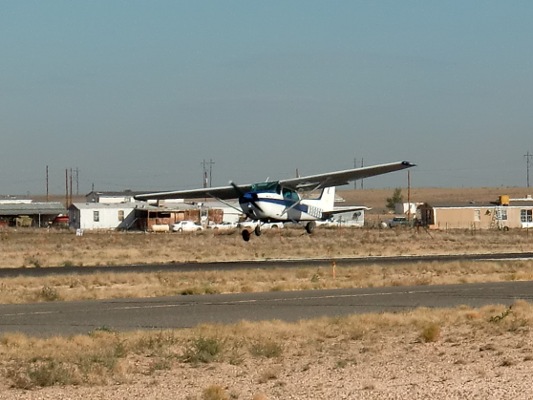
Pictured: another student from our school, demonstrating a crosswind correction in N80866.
I looked at the seat tracks the first thing, and they seemed not any worse than those in Piper. But when I tried to settle in, it turned out that at the seat hitting the rear stops, I cannot reach the controls, despite being unusually tall. No wonder that people kill themselves with unlatched seats in Cessnas, but not in Pipers.
Also, it may be related, but in every other old 4-seat GA airplane two grown Americans push the envelope in the front. In Piper Arrow, I had to use actual ballast! Not in the 172 though: we hit the envelope about 2/3 to the back.
The airplane is very easy to fly. Landings require speed control: don't land fast, don't land slow. Fortunately, it quite easy to keep on the dot (around 70 mph), unlike its older brother C-150. Also, the visibility in turns is better. The only problem that I hit was an excessive sensitivity in the pitch, like what LSAs are roundly reputed to have.
While we were practicing, flaps died on us. It was not the breaker. Either the actuator motor went kaputt, or a wire fell off somewhere. Fortunately, they were retracted when they failed, so we just continued without any drama. Many people dislike electric flaps for the reason of potential failure, but even after today I am not with them. I had flaps on Cherokee unlatch on me with a tremendous slam. Good thing I wasn't landing at a short field at the time!
Posted by: Pete Zaitcev at
07:55 PM
| No Comments
| Add Comment
Post contains 268 words, total size 2 kb.
23 queries taking 0.0131 seconds, 26 records returned.
Powered by Minx 1.1.6c-pink.