




July 21, 2013
At PoA, they have a section where people can post anonymously, to discuss safety issues frankly. Someone posted this today:
A couple years ago I busted a TFR when the president was visiting the big city in my local area. I was so clueless I took off right into it just to go fly around for fun on a Sunday morning. That's what you get for not checking, or reading the newspaper, or turning on the radio on the drive to the airport. I was doing touch and goes at a little airport about 20 miles away when the attendant Tom (not his real name) there called me on unicom to tell me that the Secret Service was on the phone and that they wanted to talk to me, NOW. It was very embarrassing and all the authorities were very kind and apologetic about everything including suspending me for 45 days.
Fast forward to a couple days ago when I landed at the same airport again and introduced myself to Tom the attendant as that idiot who'd busted the TFR. After a laugh he said he had an even better story about busting a TFR.
The president was in town. Not the big town nearby but at the same town his airport was in. The local National Guard was on alert at the field. A portable surveillance radar truck was brought in and set up at the airport. The Secret Service set up a command post at the airport. Nothing was moving. Quiet hours passed.
Then, as Tom tells it, a small single engine plane landed and taxied up. It was a local pilot based at this airport. He was on his day off from his job as a 747 pilot. He didn't know about the TFR and "turned white as a sheet" when informed. They both looked around and realized that apparently no one had yet noticed the little plane. So, they quickly and nonchalantly pushed it into a hanger and went about their business.
Tom ended his story with this, "The best part is that when that plane landed the Secret Service guys were in the pilots lounge playing Monopoly! They never noticed a thing!"
Emphasis mine. You can see why the guy turned white: his career would be ruined completely if he were busted.
Posted by: Pete Zaitcev at
07:08 PM
| No Comments
| Add Comment
Post contains 390 words, total size 2 kb.
July 11, 2013
Pilot boards are still abuzz with the SFO crash and, naturally, some people lean towards discussing the Asian flying skills, as we seen previously. Today they finally reached outside of Korea:
Japanese flight students tend to be the better Asian students that you'd want to be assigned. Although there was that guy in one of IASCO's King Airs that came up on Oakland Center reporting VFR at 19.5 requesting flight following. Oakland came back with an incredulous, "19.5? You can't be there!" To which JAL replied, "No, we can. This SUPER KingAir!"
Spoiler: Class A over CONUS begins at 18 thousand. Getting there while under VFR is unlawful. Here's what Bob Gardner wrote in "Say Again, Please":
Almost every Center controller has a story about an exchange with a pilot who has been legally flying in Class A airspace:
PILOT: "Center, are you talking to that Centurion [or Malibu, or 340, or...] at my two o'clock, about my altitude?"
CENTER: "Negative. He's squacking VFR and we're not talking to him. Are you close enough to get his tail number?"
Posted by: Pete Zaitcev at
07:27 PM
| No Comments
| Add Comment
Post contains 178 words, total size 1 kb.
July 09, 2013
Someone posted an anonymous enough e-mail to PPRune, which had a few interesting passages. First, I'm going to point out what I see as a contradiction:
Actually, this is a worldwide problem involving automation and the auto-flight concept. Take one of these new first officers that got his ratings in the US or Australia and came to KAL or Asiana with 225 flight hours. After takeoff, in accordance with their SOP, he calls for the autopilot to be engaged after takeoff. How much actual flight time is that? Hardly one minute. Then he might fly for hours on the autopilot and finally disengage it (MAYBE?) below 800 ft after the gear was down, flaps extended and on airspeed (autothrottle). Then he might bring it in to land. Again, how much real flight time or real experience did he get. Minutes!
The Koreans are very very bright and smart so I was puzzled by their inability to fly an airplane well. They would show up on Day 1 of training (an hour before the scheduled briefing time, in a 3-piece suit, and shined shoes) with the entire contents of the FCOM and Flight Manual totally memorized. But, putting that information to actual use was many times impossible. Crosswind landings are also an unsolvable puzzle for most of them.
Emphasis mine. Apparently they fly through the flare and touchdown by hand, and yet crosswind landings are supposed to be an unsolvable puzzle? Whenever a glossy magazine posts an article "how to stay current on 35 hours a year", they say the same: cut circuits around a field. You have no time, so do not fly anywhere, just fly patterns. This is the most critical skill, so make sure it decays last.
Someone may suppose that they just slam it down in crab, fine, but at least they flare and manage throttles.
Then there's this:
[...] He also failed to put in ANY aileron on takeoff with a 30-knot direct crosswind (again, the weather was dictated by KAL).
Umm, what? Honestly, the only reason why I start with full aileron on crosswind is to prevent accidential rolling on downwind wheel and being thus blown off the runway (or flipped clear over). As the speed builds up, I start sensing the force and relax ailerons accordingly. I found that even in stiffest cross-winds that I am comfortable to tackle (say, about 20G25 knots), the required aileron is miniscule. I only continue this technique in case of a gust (N.B. This is different in a taildragger). I strongly suspect that a 737 would not care for 30 knot cross-wind with neutral ailerons. Now if it's blowing 55G65, this may be a problem. But still, some of those captains may fly for years and not hit a situation like that.
So, with Mic's friend's credibility under a slight question mark, here's the really interesting part:
The other thing that I think plays an important role is the fact that there is virtually NO civil aircraft flying in Korea. It's actually illegal to own a Cessna-152 and just go learn to fly. Ultra-lights and Powered Hang Gliders are Ok. I guess they dont trust the people to not start WW III by flying 35 miles north of Inchon into North Korea. But, they dont get the kids who grew up flying (and thinking for themselves) and hanging around airports. They do recruit some kids from college and send then to the US or Australia and get them their tickets. Generally, I had better experience with them than with the ex-Military pilots. This was a surprise to me as I spent years as a Naval Aviator flying fighters after getting my private in light airplanes. I would get experienced F-4, F-5, F-15, and F-16 pilots who were actually terrible pilots if they had to hand fly the airplane. What a shock!
First things first: don't dump on ultralights. But more importantly, this prompts a couple of observations.
First is Japan. Japanese fly almost as freely as Americans, or more like Europeans. But anyhow, it's something possible (I'm going to report on that separately). So, Japanese pilots should be decent stick and rudder men. Therefore, if you are afraid of an accident like Asiana's, fly with JAL or ANA.
Second is America. It is well known that personal aviation is collapsing, and this is a concern for the pilot training. If the GA is removed from the picture, and legions of freelancing instructors are forced to change careers, who's going to prepare pilots? Korean-style academies, that's who. Embry-Riddle is going to ramp up.
I think that safety-wise, it's not going to be a disaster that proponents of GA predict. Russians have no GA to speak about, yet most of them are good aviators. Heck, they solo in Yak-18 at 9 hours. If you can't make the cut, you're out of the program. They also die in training accidents a lot, which is probably what happens when healthy disregard for authority cannot find a better channel.
I still mourn GA, just not because of forecast difficulties with airline staffing.
Posted by: Pete Zaitcev at
08:54 PM
| No Comments
| Add Comment
Post contains 856 words, total size 5 kb.
July 07, 2013
The ADS-B, or "Automatic Dependent Surveilance, Broadcast", system is implemented on every airliner and is slated to become mandatory on every airplane in Class A, B and C airspace in 2020 (the cost of implementation is a big concern for owners of small private aircraft). The "broadcast" part means that aircraft broadcast their status, such as position and velocity. FAA facilities on the ground receive the data and make it available to the public.
Yeah. Imagine a world where everyone, anywhere, can track your car at all times, as long as they know its plate number. Unless you're a government nabob, of course — then you can opt out through the BARR program. But the rest of you suckers are screwed.
On the upside, ADS-B data allows Internet investigators look in detail at the flight profile of the Asiana Boeing 777 that crashed today in San Francisco. The incident flight is marked blue at the graphs below:


It seems obvious that the Asiana pilot got a shade high on final, then chopped the throttles, but forgot to spool up in time, and allowed the airspeed to decay way below Vref, which appears to be about 150 knots in this case. Other flights on the graphs are other 777 flights that landed at SFO.
Now, it is possible that something was wrong with the power, but highly unlikely. Surviving passengers reported that engines went full power just before the crash. But who didn't do the same in a Cessna 150? The difference is, you can slam the throttle in 150 and it revs up instantly. A jet requires a sharper eye for glide path deviations, and earlier, smoother corrections.
UPDATE: Note that I'm presuming above that the airplane was flown by hand because ILS was off. However, the big iron has enough tricky modes nowadays that it may not the the case. Someone at PPRune speculated that Flight Level Change (FLCH) could be involved (via PoA):
If [while in FLCH] the Asiana was a bit high (quite normal for SFO) then regained the visual glideslope, the rate of descent would have decreased and the speed would have started slowly reducing but with the thrust levers staying at idle the 777 would now be in the same situation as the Turkish 737 at AMS, ie speed decreasing below Vref and not being noticed.
The 777 has autothrottle wake up, ie when the aircraft approaches a stall the power comes on automatically to almost full power. This gives pilots great confidence however autothrottle wake up is inhibited in FLCH.
So 777 pilots will be looking at this scenario and wondering if Asiana were in FLCH with flight directors on, too high, stabilised late and did not notice they were still in FLCH and that the autothrottle was not keeping the speed to Vref plus 5 untl too late.
It's crazy how much airline pilots have to keep in mind about equipment modes. See the Karlene's old post for a great example.
UPDATE: Ken asked for my thoughts, but what more can be said? Know your airplane, fly your airplane. There does not seem to be anything else to be learned from this accident.
Posted by: Pete Zaitcev at
07:34 AM
| No Comments
| Add Comment
Post contains 533 words, total size 4 kb.
June 30, 2013
A post by Janice Wood reminded me about the so-called "moose stall": a stall that occurs when the pilot circles an object on the ground, canonically a dead moose. It reliably kills pilots in Alaska and Canada. Shaun Lunt, a student of Loni Habersetzer, was killed in a moose stall incident. Shaun was a co-star of Loni's DVD "Cubdriver Alaska" and you can be sure that his piloting skills were top notch.
My perosnal view is that the mortal hazard of the moose stall comes from it being extremely insidious. I am sure that Shaun died because he did not realize the hazard. Indeed, all of us performed a turn around a point. Every pilot is well familiar with the maneuver and is not likely to think of it as something that dangerous. But it is, and the only way to survive it is not to do it at all (except on a dual).
Loni's other DVD ironically includes a trick that could've saved Shaun life if it weren't published too late. When Loni goes to hunt for cast off antlers and identifies a candidate, he flies a racetrack pattern. Looking at the focus point while flying straight and level dramatically decreases task load -- even for a master pilot like Loni.
Of course you have to reacquire the moose on each pass, unless an observer can keep an eye on it, but think what is more important for you, and excercise discipline.
Posted by: Pete Zaitcev at
08:52 PM
| No Comments
| Add Comment
Post contains 246 words, total size 2 kb.
June 22, 2013
At his WSJ blog (h/t Instapundit), James Taranto describes his interactions with feminism thus:
Meanwhile, the Ms. Foundation for Women, in cooperation with an outfit called the Service Women's Action Network, has started an online petition "calling for the disciplining of" your humble columnist, whom they graciously describe as "prominent." They find no fault with our account of the facts; they complain only of our "framing the campaign as a 'war on men' " and of a few phrases they find neuralgic.
That is to say, they want a journalist to be punished for committing journalism -- for accurately reporting the news and expressing an opinion contrary to feminist orthodoxy. It is a lovely example of the totalitarian mindset that is the core of contemporary feminism.
Indeed.
Posted by: Pete Zaitcev at
04:24 PM
| No Comments
| Add Comment
Post contains 131 words, total size 1 kb.
June 16, 2013

From Namichigawa Muromi-san, 11.
Posted by: Pete Zaitcev at
07:43 PM
| No Comments
| Add Comment
Post contains 8 words, total size 1 kb.
June 06, 2013
Last Sunday I was almost literally in the middle of nowhere, in the desert near Arizona border, when I saw this:

Isn't it a beauty, with the faded paint and incorrect spinner?
Posted by: Pete Zaitcev at
05:07 PM
| No Comments
| Add Comment
Post contains 38 words, total size 1 kb.
May 30, 2013
Seen at the venue blog in near-transcript:
Musk: The high-speed rail that’s been proposed will be the slowest bullet train in the world and the most expensive, and it’s a little depressing.
Mind, this is a big Obama supporter and donor, who once went on record saying it would be "optimal" if government produced 40% of a country's GDP. And he didn't mention how Dianne Feinstain's husband was awarded a big contract to implement that train. But even he's made depressed.
Posted by: Pete Zaitcev at
07:48 AM
| Comments (2)
| Add Comment
Post contains 87 words, total size 1 kb.
May 29, 2013
As seen at ANN (a different one):
A lawsuit has been filed in Tama County District Court in Toledo, IA, stemming from an accident which fatally injured two people on board a Taylorcraft BC12-D. The airplane struck power lines and went down on approach to landing. The passenger on board the airplane survived the accident, but later died of his injuries.
Usually this ends with the estate hitting the ariplane maker, but in this case we're talking an airplane made perhaps in 1946, and so there was a twist:
The suit was brought by Susan Morrison, the wife of Max Morrison, who was a passenger on board the T-Craft. Morrison died January 7 of injuries sustained in the accident, according to the Tama News-Herald. She has named the estate of William Konicek Jr. the pilot of the airplane, as the defendant in the case.
Stuff like this is why I avoid flying passengers. You never know when one of them has a litiguous cunt among next of kin.
Posted by: Pete Zaitcev at
06:31 PM
| No Comments
| Add Comment
Post contains 171 words, total size 1 kb.
May 08, 2013
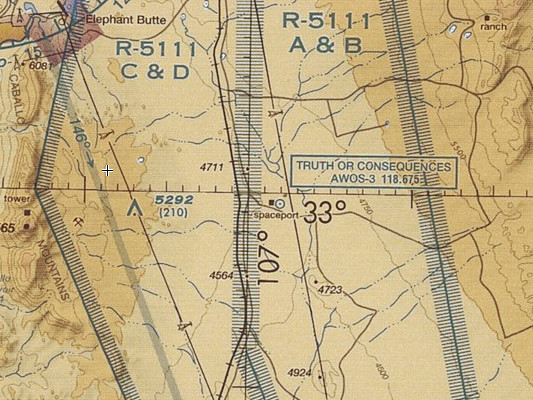
Current sectional chart introduces interesting changes: the spaceport is erased! Previously, the runway was properly documented with altitude of 4595 and length of 10,000. But now the private airport status is gone, and instead we get a landmark... And a free-standing AWOS at 118.675.
I am not entirely happy about this. It means that the powers that be put kibosh on tourists flying their own aircraft. I can imagine arguments, the chief of which is that tourists must stage at the so-called "welcome centers", which presumably include revenue opportunities for the tour operator. Still, it's disappointing.
UPDATE 2013/09/09: At the DC-X 20th Anniversary symposum, Christine Anderson made the following comments, according to The Space Review:
Anderson promises that the spaceport’s visitors center will be fun for visitors. "If you come to this spaceport, you’re going to have a good time,†she promised. "It will be fun, unlike an airport.â€
Sick burn. But it's true. Airports used to be much more inviting places than they are now, thanks to the oppressive TSA regime.
Posted by: Pete Zaitcev at
04:47 PM
| No Comments
| Add Comment
Post contains 177 words, total size 1 kb.
May 04, 2013

A member of local ultralight association has a gyroplane, and I saw it flying today. Nothing new for anyone who's been to Youtube, but still, it's quite nifty. In a nutshell, you get an aircraft that "does 90% of what a helicopter can do for 1/10th of the cost". Although a gyroplane cannot hover, it can land and take off in fairly confined spaces. Since the rotor is always in auto-rotation, an engine failure is a much less dramatic event than in a helicopter.
The most intriguing attribute of a gyroplane for me is its ability to operate in higher winds than airplanes. This problem is particularly acute in ultralight and sub-LSA airplanes with small wing loading. Many must stop operations as soon as it blows 7 knots, but a gyro easily lands in 30 knots from any direction.
Disadvantages exist as well. The "1/10th of the cost" only applies to the purchase price and maintenance, but the fuel consumption is pretty much the same as helicopter's, which is higher than in a comparable airplane. They are slow and their range is limited. The vaunted reliability is offset by rather odd handling. Remember that it's paramount to keep the air flowing through the rotor disk, so hitting a stiff downdraft may become fatal even high up. Training is hard to find and flying gyroplanes requires specialized skills.
Oh, and there's no legal way to buy a factory-new one in U.S.A. The bureaucrats forgot to include them into the LSA regulations, and nobody sells a certified model. Gyroplanes undergo a renaissance around the world, and most excellent European models have to be disassembled and then reassembled by owners using the 51% rule. Of course, unlike kitplanes, they do not become cheaper in such case. Buy American, I suppose.
So, not a silver bullet. But if I had a ranch, I would definitely look into getting one of these.
Posted by: Pete Zaitcev at
07:26 PM
| Comments (3)
| Add Comment
Post contains 321 words, total size 2 kb.
May 03, 2013
Did you know that Jack Baruth had a blog? I didn't until he commented on Facebook page of Rob Finfrock, a fellow renter of N28GX. But he does, and uses it to get back at butthurt commenters, over a rental car review. It's the kind of car review that everybody does, only Jack's was amplified by it published by TTAC. Here's something I hope comforts him, always: at least they comment.
Tags: cars
Posted by: Pete Zaitcev at
10:47 AM
| No Comments
| Add Comment
Post contains 77 words, total size 1 kb.
April 27, 2013
At my ultralight association breakfast today, I scored a fit check in a Kolb Mark III, and amazingly, it is big enough. I may even fly it in a helmet, I think. Here's a photo, with the hand demonstrating about 3 fingers of clearance:

This is the overall view of the Kolb approximately from the same angle:

Totally want one now. Of course I'm not going to be able to afford one with a Rotax 912, like the one I tried on, but I'm already imagining getting a Firestar with a Hirth cheaply and installing a Culverprops Big Twin. Two-stroke: Just Say No.
Posted by: Pete Zaitcev at
07:11 PM
| No Comments
| Add Comment
Post contains 106 words, total size 1 kb.
April 21, 2013
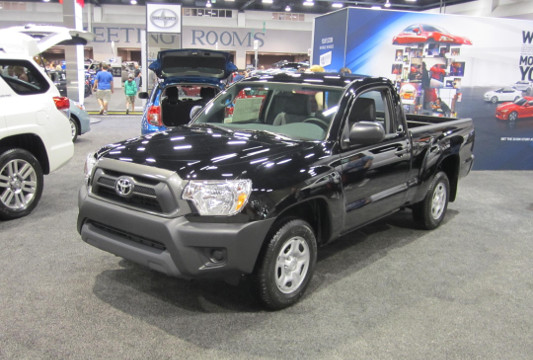
Attending this kind of event comes with certain constraints: basically it's an exhausting exercise of fit check after fit check, and a car beauty pageant. So, as a way to know cars, it's quite lopsided. But it's fun. With that in mind, a few highlights...
Mercedes C-class was a disappointment, made bigger by the surprise. It's not quite as bad inside as a rental Camry, but comes close, and nowhere in the class of, say, Lexus IS and ES. Not even in the class of BMW 3xx, which is quite nice. If BMW did something about their ghastly run-flats, I would be really interested. Unfortunately, BMW didn't bring the 1-series to the show.
A number of other interesting cars was missing, too. Nissan missed the show completely. Too bad, I meant to check out the Z. Toyota didn't bring Yaris. What's up with that? I love junk cars, and 3-door Yaris is one of the cutest. Sure, I looked at Prius C, but it's not the same.
Speaking of junk cars, GM Spark is outstanding. Of course, it's not warming the weaboo heart like Yaris, but the fake panels on the inside were amazing. Almost makes me forgive how GM assembly workers forgot to install brake pads on Spark.
Ford Fiesta and Mazda 2 turned out to be somewhat tight inside. Nothing impossible, sort of like Neon was. Of course back then Neon was surprisingly roomy, but this is 2013.
Even stranger, then, is how I simply cannot fit into Scion iQ. Headoom must be around 36 inches. The car does not look low, but I suppose the seat is too tall, and there's nothing to be done about it, absolutely nothing. Very disappointing, because I like the concept. Fitting into Mazda MX-5 is impossible too, but at least there it makes sense. It's a small sporty car and all that
In the end, Honda Fit is still the king. I hear some commenters call it "dated", which just makes no sense. In my world, there's "good" and "bad" and there's no "dated". What the heck is that, anyway? Fit is simply the best.
The cutest car at the show was actually a pickup: a Toyota Tacoma. "Cute as a button" may begin to describe it, but I am just a sucker for this kind of thing. It's a mistakenly conceived truck for the poor people: 2WD, manual, bench seating. I say mistakenly because the poor buy used full-sizers instead. Stole the show for me, really it did. See, I knew the merits of Fit beforehand, but this was a fun discovery.
To be sure, I learned a few other tidbits, too. Honda Civic retained the independent rear suspension in the age of decontenting. Honda Ridgeline has an amazingly long bed (and a clever gate). Silly commenters made me think that its bed was too short, but they knew nothing. It's a couple of feet longer than SportTrac's, possibly even longer than the bed of Crew Cab Tundra.
Oh, and finally - the Toyobaru FT86 twins: Scion FR-S and Subaru BRZ. Very nice. Low seating makes getting and out somewhat of a problem for less sporty people, but provides me with the vital headroom. Sadly the "new hachiroku" is a car that really must be driven, so there's no point in blogging it. Maybe when I crash the jeep, I'll get one. Unless I get a used BMW 135i, G37, or a Z. What a good time to be a car enthusiast.
UPDATE: Here's how Autoblog explains Fit:
Some six years later, the plucky little five-door continues to be a packaging wonder. Its flat load floor helps deliver a surprising amount of cargo area with the rear bench folded – up to 57.3 cubic feet. That number is more than twice what the Fiesta delivers, bests the Sonic by 10 cubes and the Versa hatchback by nearly seven. In fact, it's more space than class-above competitors like the Ford Focus, Hyundai Elantra GT and Mazda3 hatchbacks. And it's not just maximum cargo space where the Fit still wins, but also how those cubes are reconfigurable to accept objects of various shape and size.
Frankly this makes me concerned. Remember the original Scion xB? Remember how Toyota screwed up the redesign?
Tags: cars
Posted by: Pete Zaitcev at
04:43 PM
| Comments (1)
| Add Comment
Post contains 718 words, total size 5 kb.
April 03, 2013

I heard they are as common as Priuses around San Francisco, but it's the first time here. Local plates.
Tags: cars
Posted by: Pete Zaitcev at
07:43 AM
| No Comments
| Add Comment
Post contains 26 words, total size 1 kb.
It seems that every other language has a stock adjective or phrase applied to it. Russian is "great and powerful" ("великий и могучий"), Japanese is "beautiful" ("美ã—ã„"). But what is English? Tricky? Introspective? Universal?
Posted by: Pete Zaitcev at
05:20 AM
| No Comments
| Add Comment
Post contains 37 words, total size 1 kb.
March 22, 2013
Any time a beginner asks what to read about flying an airplane, someone suggests "Stick and Rudder: An Explanation of the Art of Flying" by Wolfgang Langewiesche. It happened to me too. But when I picked it up in Barns & Nobble, I found it unreadable. The style was just that wordy. I went with "How It Flies", and was none the worse for it. John Denker's fine book is exactly what works best if you are a physist or engineer.
Well, times change, and I wanted to have something to read before bed, so I gave "Stick and Rudder" another try. Now that I am not anxious to extract information and just read for fun, it's not that bad. The Greatest Generation writing style is actully quite amusing. And you just look at this:

It's a gentleman pilot, flying in a business suit!
Aside from amusement, I extracted a few bits of information, too. First and foremost, I imagined that the effect from the different wingtip speeds in a turn must be must larger than it actually is. But Mr. Langewiesche drew my attention to the fact that most of the adverse yaw comes from aileron deflection. No deflection - no yaw, and no rudder input! It bothered me quite a bit when I flew John's Interstate S1A. In a Cherokee, you typically have to keep a certain rudder in when turning, no matter what. Now it all makes sense.
In addition, there's a little confirmation that you should (almost) always take off downhill. Nothing a bush pilot won't know, but still.
Some of the information was a little odd. For example:
The speedier ship also needs more time to turn around in! If you fly twice as fast as need (as any given bank) twice as much time to accomplish a given change in direction.
I can understand that the radius of the turn is going to be differnt, but why the difference in turn rate? If it were the case, your T&B would be placarded at what speed to fly the standard rate turn. But it's not, is it? This is something I need to figure out from the basics.
UPDATE: Brian Morrison comments:
The turn and bank doesn't need a placard because it measures rate of turn, not bank angle and therefore automatically corrects for changes in airspeed/turn rate.
Posted by: Pete Zaitcev at
09:08 PM
| Comments (1)
| Add Comment
Post contains 398 words, total size 2 kb.
March 21, 2013
Seen at Vieille Burette:
One particularity of the RV-12 is that the Pitot tube goes through the spinner, a location that puts it away of turbulences that would make the measure of speed wrong.
Woa, Van, woa. Shades of Bf-109E here. But that's not all:
Below the Pitot tube is connecteed to the Dynamic Pressure tube that runs all the way through the cockpit to the ADAHRS located in the tailcone.
Facepalm.
UPDATE: Pat comments:
The main reason they choose that odd location was because of the removable wings.
That makes sense. However, it's not the only solution. Sonex builders usually place the pitot tube on the right wing, per plans. Some put the tube at the tail.
Posted by: Pete Zaitcev at
08:40 PM
| Comments (1)
| Add Comment
Post contains 122 words, total size 1 kb.
March 15, 2013

I skipped a few "Rental Car Review" instances mostly for not being relevant, such as Chevy Impala: The Worst Rental Ever that Almost Killed My Family (a wheel bearing was on its last miles). This Ford thing is pretty cute though.
First, the good: gosh this thing is sporty. Driving it helps one understand the appeal of the "hot hatch" in the minds of people. Personally, I was in hotter sedans before, but Focus does have its charms. Secondly, the CVT works great. Cannot say anything about its durability, but it wasn't clunking as much as Fiesta's.
Now, the bad.
The throttle requires exquisite management, and I'm not joking. It's easier to launch Focus with a manual without jerking your passenger around than with the CVT. The throttle is fully programmable and there was plenty of underutilized travel, so why did Ford choose this?
Visibility to the rear is nil. Now, I heard a lot of complaints from my family about various cars on this score over the years. Some even thought JK lacked visibility, but it never was an issue for me. Well, this is the time for me to suffer their suffering. Backing up was a crazy excercise. And there's no camera.
Finally, the thing is just plain too wide for what it is. Ford tends to go whole hog on width in general, which I noticed with the prev-gen Fusion. But man, that one was a car fighting for retirees with Buick. This one is different. Why so wide? Yeah, it helps cornering, but there must be limits.
Tags: cars
Posted by: Pete Zaitcev at
01:33 PM
| No Comments
| Add Comment
Post contains 267 words, total size 2 kb.
30 queries taking 0.0486 seconds, 74 records returned.
Powered by Minx 1.1.6c-pink.