




November 18, 2012
The usual Dan Johnson review of LSA sales of September 2012 is titled "Cessna tops LSA market list", but it contains an even more interesting tidbit than that:
One surprise is Phoenix, the sleek motorglider builder, whose U.S. importer registered four in 2012 but reports having sold 20. "We cannot keep up with orders from customers,†Jim Lee reports, "even though the production rate has increased.â€
What is Phoenix?
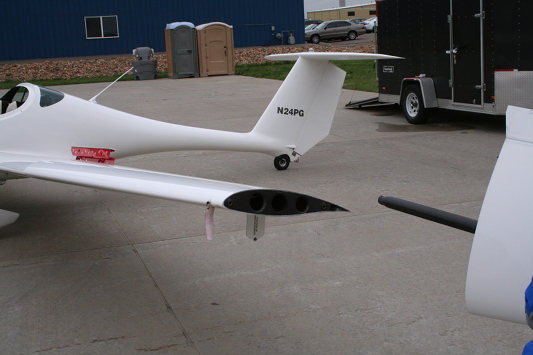
I saw one at 2011 Rocky Mountain LSA Expo. Jim Lee, the driving force between American adoption of Phoenix, flew his demo unit from his base in Florida. Not to put too fine point to it, it's an LSA-compliant low-wing motorglider with a side-by side seating.
So, what is the big deal?
The big deal is that Phoenix, being a glider, can be flown by a pilot with a denied medical certificate. But as Jim demonstrated, it's perfectly feasible to fly cross-countries in it. In other words, it's the final loophole in the regulations for people who were blindsided by the FAA.
In theory, the provision for letting the medical certificate expire should cover everyone. You track your health, and as you are getting older you know what you may not pass. Then you let the medical lapse and retain the Sport Pilot privileges. Simple, right? But in practice, it's trivial to get caught out. I am only 46, and I was.
What then? Only a glider. But a glider cannot get you anywhere... Unless it's a motor-glider!
Phoenix, however, is different from other motorgliders in that it's specifically designed to exploit the loophole. Because their engines only work for a short time, traditional motorgliders tend to have a puny fuel supply, and their engines are often inefficient and have a short lifespan. Many use 2-stroke or jet engines. Phoenix is powered by the good old Rotax 912ULS, used on many LSAs. It is economical and reliable enough for true cross-country flying.
But wait, there's more. Phoenix is also an LSA, and people are legal to fly it that way too. With only 20 hours you're good to go. But is it a good idea, especially since Phoenix is configured with a tailwheel? When I talked to Jim at the Expo, I received an impression that he was advocating reduced training. He said plainly that "one does not need a tailwheel endorsement to fly Phoenix, because it is a glider". That statement could be parsed in various ways. I was in touch with Jim since, and he explained it thus: "I would be very surprised if any gliderport in the world told a glider student to go get tailwheel training in an airplane first!" In other words, glider pilots have to deal with tricky directional control anyway. However, if you are an SP in a common LSA, it is my opinion that you need that training. It took me about 10 hours, which is not that big a deal. A 20-hour pilot may think differently, but I advise against skipping it.
The final feature of Phoenix that I would like to mention is that of its removable wingtips. The definition of a glider is a certain wingspan load (otherwise everyone would register their LSAs as gliders). I thought at first that it was a compliance trick. But Phoenix supposedly complies even with wingtips removed. The real advantage of having them is that Phoenix can be parked in a regular T-hangar.
All in all it's a remarkable airplane. Although I am far from the price bracket it is in, I am quite happy to see it finding buyers. Who knows, maybe one day I can pick one used.
Posted by: Pete Zaitcev at
10:32 AM
| No Comments
| Add Comment
Post contains 608 words, total size 4 kb.
23 queries taking 0.1323 seconds, 26 records returned.
Powered by Minx 1.1.6c-pink.